 TemperateReefBase Geonetwork Catalogue
MACROALGAE (SEAWEEDS)
Type of resources
Topics
Keywords
Contact for the resource
Provided by
Years
-
Kelps are in global decline due to climate change, including ocean warming. To identify vulnerable species, we need to identify their tolerances to increasing temperatures and whether tolerances are altered by co-occurring drivers such as inorganic nutrient levels. This is particularly important for those with restricted distributions, which may already be experiencing thermal stress. To identify thermal tolerance of the range restricted kelp Lessonia corrugata, we conducted a laboratory experiment on juvenile sporophytes to measure performance (growth, photosynthesis) across its thermal range (4 – 22 °C). We found the upper thermal limit for growth and photosynthesis to be ~ 22 – 23 °C, with an optimum of ~ 16 °C. To determine if elevated inorganic nitrogen availability could enhance thermal tolerance, we compared performance of juveniles under low (4.5 µmol/day) and high (90 µmol/day) nitrate conditions at and above the thermal optimum (16 – 23.5 °C). Nitrate enrichment did not enhance thermal performance at temperatures above the optimum but did lead to elevated growth rates at the thermal optimum 16 °C. Our findings indicate L. corrugata is likely to be extremely susceptible to moderate ocean warming and marine heatwaves. Peak sea surface temperatures during summer in eastern and northeastern Tasmania can reach up to 20 – 21 °C and climate projections suggest that L. corrugata’s thermal limit will be regularly exceeded by 2050 as south-eastern Australia is a global ocean-warming hotspot. By identifying the upper thermal limit of L. corrugata we have taken a critical step in predicting the future of the species in a warming climate.
-
The main aim of this research program was to determine the potential for reducing the density of urchins to encourage the return of seaweeds and an improvement in urchin roe quality and quantity from remaining urchins. Tasmanian Sea Urchin Developments used two widely-separated sub-tidal experimental lease areas. One of these areas was at Meredith Point, on the east coast, and the other at Hope Island, on the south coast. Both sites had been subject to some overgrazing by urchins. At Meredith Point, the study area was divided into plots containing urchins at three densities: artificially enhanced, continually harvested and control (undisturbed). At Hope Island, controlled clearings of urchins and limpets from barrens areas were conducted. Recovery of vegetation was monitored as well as urchin roe quality and quantity. The data represented by this record was collected at Meredith Point.
-
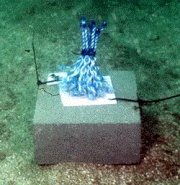
Community assembly in macrofauna communities developed in artificial kelp holdfasts was monitored at 1-month intervals over a 13 month period using a sampling design that used systematic patterns of temporal overlap and changes in start and collection dates. The hierarchical nature of the experimental design allowed several different approaches to analysis; by date of deployment and by date of collection of the artificial habitats, which enabled comparison of community assembly with and without the seasonal effects of the date of collection, and by community age to test whether there were alternative end-states to assembly depending on season or recruitment history.
-
The main aim of this research program was to determine the potential for reducing the density of urchins to encourage the return of seaweeds and an improvement in urchin roe quality and quantity from remaining urchins. Tasmanian Sea Urchin Developments used two widely-separated sub-tidal experimental lease areas. One of these areas was at Meredith Point, on the east coast, and the other at Hope Island, on the south coast. Both sites had been subject to some overgrazing by urchins. At Meredith Point, the study area was divided into plots containing urchins at three densities: artificially enhanced, continually harvested and control (undisturbed). At Hope Island, controlled clearings of urchins and limpets from barrens areas were conducted. Recovery of vegetation was monitored as well as urchin roe quality and quantity. The data represented by this record was collected at Hope Island, and includes results from an inital survey collected at the site before the main study commenced.
-

Reef Life Survey is designed to develop and resource a network of skilled recreational divers for rapid and cost-effective assessment of the state of the inshore marine environment at the global scale. The project uses standardised underwater visual census methods employed by trained SCUBA divers to survey fish and invertebrate species and to record habitat type using photo quadrats - this particular dataset refers to the photo quadrats only. This data has been superseded by the NRMN collection "IMOS - National Reef Monitoring Network - Benthic cover data (in situ surveys)": see https://catalogue-imos.aodn.org.au/geonetwork/srv/eng/catalog.search#/metadata/ec424e4f-0f55-41a5-a3f2-726bc4541947
-
The data is the percent algal cover derived from underwater visual census methods involving transect counts at rocky reef sites around Tasmania. This data forms part of a larger dataset that also surveyed fish and megafaunal invertebrate abundance for the area. The aggregated dataset allows examination of changes in Tasmanian shallow reef floral and faunal communities over a decadal scale - initial surveys were conducted in 1992-1995, and again at the same sites in 2006-2007. There are plans for ongoing surveys. An additional component was added in the latter study - a boat ramp study looking at the proximity of boat ramps and their effects of fishing. We analysed underwater visual census data on fishes and macroinvertebrates (abalone and rock lobsters) at 133 shallow rocky reef sites around Tasmania that ranged from 0.6 - 131 km from the nearest boat ramp. These sites were not all the same as those used for the comparison of 1994 and 2006 reef communities. The subset of 133 sites examined in this component consisted of only those sites that were characterized by the two major algal (kelp) types (laminarian or fucoid dominated). Sites with atypical algal assemblages were omitted from the 196 sites surveyed in 2006. This study aimed to examine reef community data for changes at the community level, changes in species richness and introduced species populations, and changes that may have resulted from ocean warming and fishing. The methods are described in detail in Edgar and Barrett (1997). Primarily the data are derived from transects at 5 m depth and/or 10 m depth at each site surveyed. The underwater visual census (UVC) methodology used to survey rocky reef communities was designed to maximise detection of (i) changes in population numbers and size-structure (ii) cascading ecosystem effects associated with disturbances such as fishing, (iii) long term change and variability in reef assemblages.
-
The data is quantitative abundance of fish, megafaunal invertebrates and percent algal cover derived from underwater visual census methods involving transect counts at rocky reef sites around Tasmania. This dataset allows examination of changes in Tasmanian shallow reef faunal and floral communities over a decadal scale, with initial surveys conducted in 1992-1995, and again in 2006-2007. There are plans for ongoing surveys. An additional component was added in the latter study - a boat ramp study looking at the proximity of boat ramps and their effects of fishing. We analysed underwater visual census data on fishes and macroinvertebrates (abalone and rock lobsters) at 133 shallow rocky reef sites around Tasmania that ranged from 0.6 - 131 km from the nearest boat ramp. These sites were not all the same as those used for the comparison of 1994 and 2006 reef communities. The subset of 133 sites examined in this component consisted of only those sites that were characterized by the two major algal (kelp) types (laminarian or fucoid dominated). Sites with atypical algal assemblages were omitted from the 196 sites surveyed in 2006. This study aimed to examine reef community data for changes at the community level, changes in species richness and introduced species populations, and changes that may have resulted from ocean warming and fishing. The methods are described in detail in Edgar and Barrett (1997). Primarily the data are derived from transects at 5 m depth and/or 10 m depth at each site surveyed. The underwater visual census (UVC) methodology used to survey rocky reef communities was designed to maximise detection of (i) changes in population numbers and size-structure (ii) cascading ecosystem effects associated with disturbances such as fishing, (iii) long term change and variability in reef assemblages.
-
Seasonal patterns in the in situ ecophysiology of the common habitat-forming seaweeds Ecklonia radiata, Phyllospora comosa, and Macrocystis pyrifera were investigated at different latitudes and depths in southeastern Australia. We used multiple performance indicators (photosynthetic characteristics, pigment content, chemical composition, stable isotopes, nucleic acids) to assess the ecophysiology of seaweeds near the northern and southern margins of their range, along a depth gradient (E. radiata only), over a two year period (September 2010 – August 2012).
-
Shifts from productive kelp beds to impoverished sea urchin barrens occur globally and represent a wholesale change to the ecology of sub-tidal temperate reefs. Although the theory of shifts between alternative stable states is well advanced, there are few field studies detailing the dynamics of these kinds of transitions. In this study, sea urchin herbivory (a ‘top-down’ driver of ecosystems) was manipulated over 12 months to estimate (1) the sea urchin density at which kelp beds collapse to sea urchin barrens, and (2) the minimum sea urchin density required to maintain urchin barrens on experimental reefs in the urbanised Port Phillip Bay, Australia. In parallel, the role of one of the ‘bottom-up’ drivers of ecosystem structure was examined by (3) manipulating local nutrient levels and thus attempting to alter primary production on the experimental reefs. It was found that densities of 8 or more urchins m-2 (≥ 427 g m-2 biomass) lead to complete overgrazing of kelp beds while kelp bed recovery occurred when densities were reduced to ≤ 4 urchins m-2 (≤ 213 g m-2 biomass). This experiment provided further insight into the dynamics of transition between urchin barrens and kelp beds by exploring possible tipping-points which in this system can be found between 4 and 8 urchins m-2 (213 and 427 g m-2 respectively). Local enhancement of nutrient loading did not change the urchin density required for overgrazing or kelp bed recovery, as algal growth was not affected by nutrient enhancement.
-
The phenotypic plasticity of habitat-forming seaweeds was investigated with a transplant experiment in which juvenile Ecklonia radiata and Phyllospora comosa were transplanted from NSW (warm conditions) to Tasmania (cool conditions) and monitored for four months. We used multiple performance indicators (growth, photosynthetic characteristics, pigment content, chemical composition, stable isotopes, nucleic acids) to assess the ecophysiology of seaweeds before and following transplantation between February 2012 and June 2012.